
Head-to-head · Updated August 5, 2026
Quicken Simplifi vs. Copilot Money
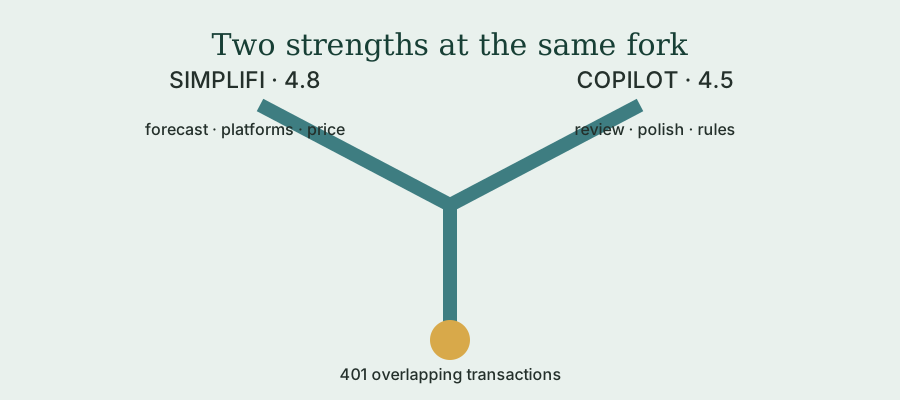
Two excellent dashboards diverge at the same fork: Simplifi looks ahead; Copilot makes the present easier to inspect.
Quicken Simplifi wins this 2026 comparison, 4.8/5 to Copilot Money’s 4.5/5. Simplifi offers better projected cash flow, broader device access and a lower annual price. Choose Copilot instead if you use Apple devices exclusively and want the fastest, most polished daily transaction-review experience.
The result at a glance
| Category | Quicken Simplifi | Copilot Money | Winner |
|---|---|---|---|
| Annual price | $71.88 regular; $35.88 first-year offer seen | $95 annually | Simplifi |
| Monthly option | Annual billing | $13 month to month | Copilot for flexibility |
| Transaction review | Reliable and clear | Fastest flow tested | Copilot |
| Forward planning | Projected cash flow and Spending Plan | Budgets and cash-flow history | Simplifi |
| Platforms | Web, iOS, Android | Apple-centered | Simplifi |
| Household use | Space Sharing; broad access | Joint data, lighter multi-user support | Simplifi |
| Visual design | Clean and practical | Exceptionally polished | Copilot |
| Overall score | 4.8/5 | 4.5/5 | Simplifi |
We tested Simplifi for 35 days and Copilot for 32, using overlapping checking, savings, credit-card and investment accounts. The test included 401 imported transactions. This was not a feature-box exercise: each app lived through paydays, card autopays, an annual insurance charge, reimbursements and a credit-union reconnection.
Budgeting and planning: Simplifi
Simplifi’s Spending Plan subtracts recurring bills, planned savings and selected planned spending from expected income. Its projected cash-flow graph then places upcoming commitments against actual account balances. During testing, that sequence exposed a two-day cash pinch before it became an overdraft risk. Copilot showed the same obligations, but the future balance was less central to the experience.
Copilot’s category budgets are easy to read and support rollovers. They work well for monitoring a stable month. Simplifi is better when payment timing matters, income varies slightly, or a user wants to see whether a current decision creates trouble three weeks downstream. YNAB is still more rigorous than either for zero-based budgeting.
Transactions and rules: Copilot Money
Copilot categorized 96.3% of our transactions usefully on the first pass; Simplifi reached 94.4%. Those numbers are close, but Copilot’s advantage is experiential. Its review flow makes confirming, changing and teaching a rule feel like one uninterrupted action. Simplifi’s controls are capable, though more administrative.
Copilot wins for users who want a brief daily money ritual. Simplifi works well for a weekly review, particularly when that session includes checking the forecast and watchlists. Both applications improved after one week of corrections. Neither should be trusted to interpret transfers or mixed-purpose retailers perfectly without human review.
Price and trial structure: Simplifi, with a caveat
On August 5, 2026, Simplifi displayed $2.99 per month billed annually for the first year, or $35.88, against a stated regular price of $5.99 per month billed annually, or $71.88. Copilot listed $95 annually or $13 monthly. Simplifi wins on continuing annual price, while Copilot is the only one of the pair offering a true monthly payment route.
The caveat is commitment. Simplifi’s discounted number is promotional, so renewal should be evaluated at the regular price. Copilot’s $95 annual plan is simpler to understand but materially higher. Neither offers a permanent free tier. Our complete app ranking includes free manual and limited automatic alternatives.
Platforms and households: Simplifi
Simplifi works through a browser plus iOS and Android apps. Copilot’s core experience is designed around Apple hardware. For one iPhone-and-Mac user, this may not matter. For a couple with an Android phone, a shared Windows computer or strict separation between personal devices, it matters immediately.
Simplifi’s Space Sharing lets an account owner invite another person into a distinct financial space. It is not the most sophisticated household permission system in the category, but it is more practical across mixed devices. Copilot can consolidate joint and individual accounts; it simply feels designed first for one person’s coherent view.
Investments, reports and recurring charges: a draw
Both products track net worth and investment balances without replacing dedicated portfolio software. Copilot’s presentation is more attractive. Simplifi’s reports and watchlists are more flexible when tracking merchants, tags or categories. Neither is the correct tool for tax lots, cost-basis decisions or small-business books.
Recurring detection was good in both tests. Each required correction around annual or irregular charges. Copilot displayed recurring activity elegantly; Simplifi made those items more consequential by feeding them into the Spending Plan and projected balances. Which is “better” depends on whether the purpose is awareness or planning.
Privacy and data handling: read both policies
Both apps require sensitive read access to deliver automatic aggregation. We checked published security and privacy materials, account controls and deletion routes; neither received a perfect privacy score. Users should enable multi-factor protection where available, connect only accounts needed for the intended view and close old app accounts instead of abandoning them.
ThriftBrook does not reproduce broad “bank-level security” claims as evidence. Security depends on the entire chain: the app, its data providers, your email account, your device and your financial institutions. Our selection guide explains the checks to make before connecting anything.
The decision in one minute
Choose Quicken Simplifi if you manage money on more than Apple devices, share a household plan, think about upcoming balance timing or want the lower annual price. Read our full Simplifi review for the setup details and weighted score.
Choose Copilot Money if you use Apple devices, will review transactions frequently and consider interface quality part of financial consistency. Our Copilot review explains why its 4.5/5 remains a strong result rather than a consolation prize.
Frequently asked questions
Which is better, Quicken Simplifi or Copilot Money?
Quicken Simplifi is better for most households because it combines forward cash-flow planning, web and Android access, and a lower regular annual price. Copilot Money is better for Apple-only users who value interface polish and fast transaction review above household access. Our scores are 4.8 and 4.5.
Which app is cheaper?
Simplifi is cheaper. On August 5, 2026, its regular price was $5.99 monthly, billed annually at $71.88, with a lower first-year promotion displayed. Copilot cost $95 annually or $13 month to month. Always check renewal terms because promotional Simplifi pricing changes.
Which app is better for couples?
Simplifi is the better default for couples, particularly when partners use different devices. Its browser, iOS and Android access plus Space Sharing are more flexible. Copilot can hold joint accounts, but its Apple-first product and less developed multi-user structure create more friction for many households.
Can either app replace a spreadsheet?
Yes, if your spreadsheet mainly tracks spending, recurring bills, balances and category targets. Simplifi is the stronger replacement for a forward-looking monthly plan; Copilot is stronger for reviewing activity and monitoring trends. Neither replaces detailed tax, small-business or investment accounting.